
A responsible seminar isn’t won or lost on water bottles or recycling bins. It comes down to three decisions made very early on, often without much thought: how your teams travel, how many venues you visit, and the address book you draw your suppliers from. These three choices write most of the event footprint. Everything that comes after is a matter of intention.
In this article
- The footprint is written in January
- What does a responsible seminar actually mean ?
- Decision 1. The map of departures before the map of France
- Decision 2.What the venue already brings to the table
- Decision 3. The address book
- What’s left to decide
- frequently asked questions
The countdown begins in january
The brief lands when everyone gets back from holiday. A hundred and eighty people, a full day, a venue that stands out, a budget that holds. You list destinations, compare three sites, set a retro-planning schedule. Somewhere between the third and fourth meeting, someone asks whether it couldn’t be done a bit more responsibly. Everyone nods. The idea gets noted, to come back to later.
The briet comes back in May, once everything is signed. By then, all that’s left are the water bottles, the recycling, and a word from the director on the company’s commitment. The event’s actual footprint, meanwhile, was already written in January.
ADEME says it plainly on its website : “participant and attendee travel is often the most significant source of CO2 emissions.” Step back from any seminar and there’s really only one thing left to see: kilometers. Those covered by your participants. Those covered by the equipment that has to be brought in. Those covered by the suppliers who set up, serve, run activities, and leave again.
Three flows, so three decisions. They’re made before the brief is even written, which is exactly why they tend to be made badly.
What does a responsible seminar actually mean?
A seminar where you’ve cut the impact where it’s actually real, then measured what’s left. That’s the whole point of ISO 20121, revised in 2024, the standard governing responsible event management: identify what weighs heaviest, act on it, report on it.
So it doesn’t mean giving up a beautiful venue or a strong moment for your teams. A dull seminar has never moved anyone forward, and no one is asking you to choose between the two. Nor does it mean lining up visible gestures that leave the bulk of the footprint untouched: sorting your waste is reassuring, but it doesn’t offset three hundred round-trip flights. As for carbon offsetting, it deals with what’s left over. It has never replaced a decision made in time.
Two companies can say exactly the same things and walk away with completely different results. The difference comes down to three or four calls made during the planning stage.
Decision 1. The map of departures before the map of destinations
Let’s start with the order of magnitude, because it’s worth putting in black and white. Per traveler and per kilometer, a TGV journey emits 3.5g of CO2e according to SNCF’s 2025 GHG methodology note. A car emits 89g with 2.2 people on board, and a short-haul flight 125g, according to ADEME’s 2024 Base Empreinte database.
A factor of twenty-five separates train from car. No other decision in your day carries that kind of weight, and it’s the one made fastest.
Hence a habit worth adopting, almost trivial and yet rare: open the list of participants before the list of destinations. Where do they live, where are they leaving from, how many of them could get there by train? The question sounds mundane. Yet it decides more than anything else in your brief.
Biarritz does well on this front. The TGV station is right in town, and Paris is 4 hours away. We’ve dedicated a whole article to the area’s accessibility, « Séminaire au Pays basque : pas besoin d’aller au bout du monde », which covers this in more depth than this paragraph can.
That leaves the last stretch, the one that always gets overlooked. Here, it lives up to its name: the station is five minutes from Le Connecteur. Over a distance like that, the mode of transport barely matters, whether your participants arrive by shuttle, taxi or car. What you gain, above all, is time and calm, on a morning when a hundred and eighty people converge within the space of an hour.
Decision 2. What the venue already brings to the table
The second flow is less visible, because it’s not about people but about crates, cables and trucks. Its logic fits in one sentence: what’s already on site doesn’t need to travel.
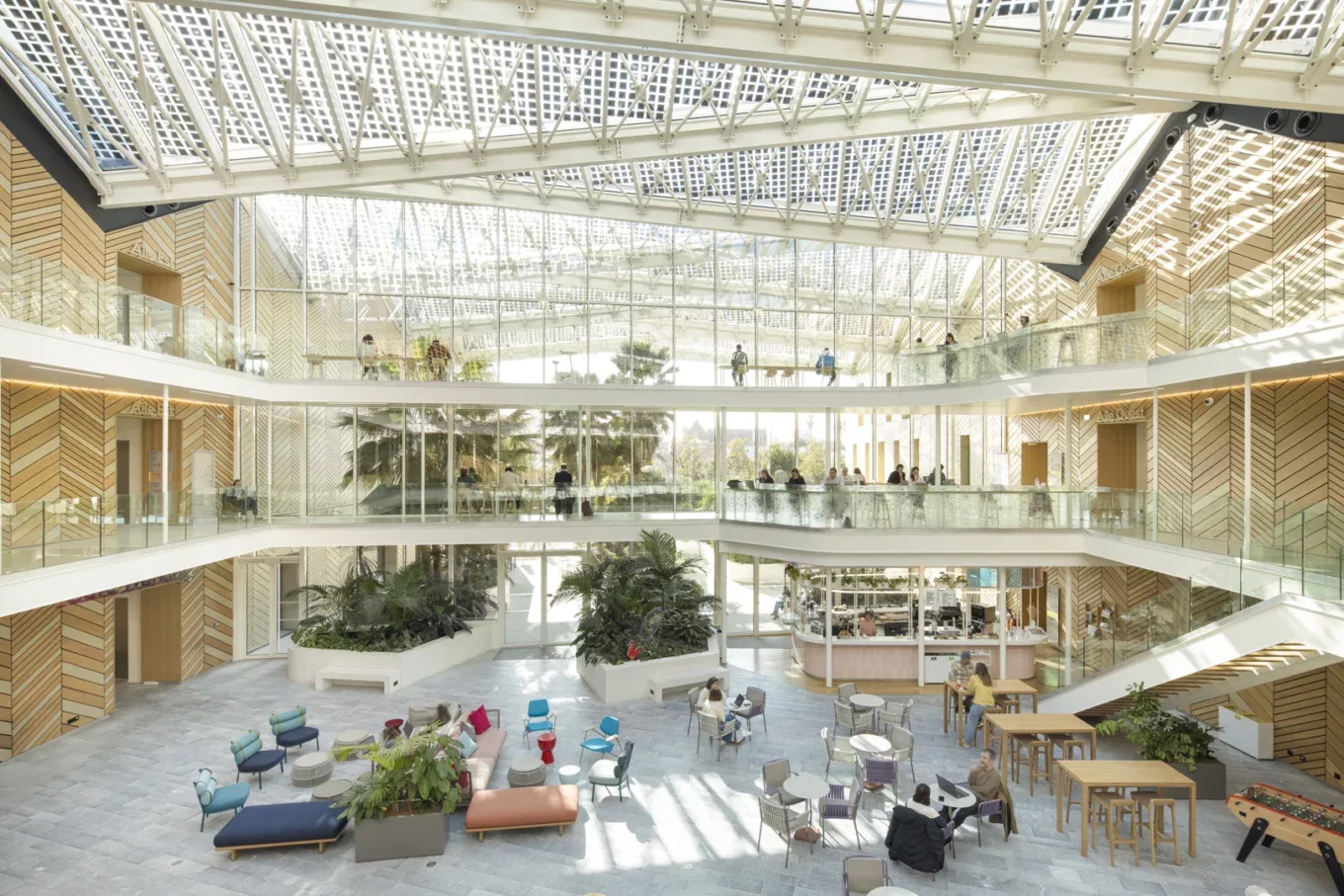
Start by counting addresses. A day split across two or three sites costs you shuttles, duplicated equipment transport, and a good hour of downtime for your participants. A day that stays in one place, by contrast, runs without transfers and can be managed from a single point. At Le Connecteur, the plenary session, workshops, breaks, lunch and informal moments are spread across 8,300 m²: the atrium holds up to 360 people, the auditorium 303, the amphitheater 90, the forum 150, the rooftop 100, and our many meeting rooms allow the day to be broken up as needed.
Then comes the technical side, and it’s often the pleasant surprise. A 31.68 m² screen equips the auditorium, sound systems, control booth, signage and display screens are all permanently installed, and a full-time technical manager works here year-round. You rent nothing, ship in nothing, and return nothing the next morning. Every truck that doesn’t have to come is one less line in your footprint, and one less worry the night before.
The building itself has followed the same rule since it was built: produce more, consume less. Over 1,400 m² of photovoltaic panels and a cogeneration boiler produce 200,000 kWh. On the consumption side, a centralized building management system adjusts lighting, temperature and ventilation to actual occupancy, air conditioning cuts out as soon as windows are opened, and LED fixtures adjust to daylight. The materials tell the same story, with 1,100 m² of Arudy stone across the forecourt and atrium, 2,125 plantings, two rooftop beehives, and green spaces maintained without pesticides.
Decision 3. The address book
That leaves everything the venue doesn’t provide, and the list is long. An event brings together some twenty different trades: caterers, craftspeople, destination management agencies, printers, graphic designers, DJs, musicians, hosts, presenters. Each one arrives with their own kilometers, equipment and waste.
You rarely choose these suppliers yourself. You choose a venue, and the venue opens its address book to you. Knowing where those addresses actually come from is well worth a question at your next meeting.
A caterer twenty minutes away and a caterer four hours away don’t serve the same meal, carbon-wise. The same rule applies to printing, staging and entertainment. It also decides what your budget leaves behind, in the very region you chose precisely for its character.
Our suppliers are local, and that’s a longstanding choice. Caterers, craftspeople, destination management agencies, printers, technicians: the team works with suppliers it knows, and who know the building. You save kilometers, but also hours of coordination, which shows on the day itself. The same logic applies to the venue’s day-to-day operations, with locally roasted coffee, cigarette butts collected by Tree6clope, and organic waste handled by Les Alchimistes.
Team building follows the same rule, and it’s probably where it’s most enjoyable to apply. A rugby taster session, beach games, a cycling outing, an escape game: it’s all put together here, with local providers. Your teams come away with the memory of a place rather than an interchangeable activity, and nobody had to cross the country to organize it.
On your side, a single project manager oversees everything, before, during and after, drawing on more than 1,000 events held here since 2021.

What’s left to decide
Three questions are enough for the first planning meeting. Where will your participants be leaving from, and how many could come by train? How many addresses does the day require, and what does the venue already provide without outside rental? Where do the suppliers you’ll be offered actually come from? Ask them in that order and you’ll have covered the essentials before decor even comes up.
The mistakes, meanwhile, all look alike. Choosing the destination before looking at where the teams are coming from. Putting sustainability on the last page of the brief, once every decision has already been made. Taking care of what’s visible and letting what actually matters slip through. Forgetting to measure, so there’s nothing to improve on next year.
None of this calls for giving anything up. A distinctive, well-equipped, well-connected venue reduces your impact instead of adding to it. Your teams, for their part, will remember the day not the footprint.
Frequently asked questions
Does a responsible seminar cost more ?
Not necessarily. The decisions that have the greatest impact on the budget often end up reducing the total cost: fewer trips, fewer shuttles, and less equipment to rent and transport. Any additional costs tend to arise in secondary areas for instance, by opting for high-quality catering.
What’s the biggest source of emissions in a corporate seminar?
Participant travel. ADEME states that participant travel is often the most significant source of CO2 emissions at an event. The published breakdowns refer to specific cases and don’t transfer directly to a corporate seminar.
Do you have to give up an out-of-the-ordinary venue?
No. A distinctive, well-equipped, well-located venue reduces your impact rather than increasing it: it avoids transfers, equipment rentals, and suppliers coming from far away.
How do you measure a seminar’s carbon footprint?
Start with travel: ask each participant their departure city and travel mode, then use ADEME’s Impact Transport simulator. Then add catering, accommodation and equipment produced specifically for the occasion.
What is the ISO 20121 standard?
ISO 20121 is the international standard for responsible management systems applied to event activity. Published in 2012 and revised in 2024, it provides a framework for identifying an event’s impacts, acting on them, and reporting on the results.
How many people can Le Connecteur host?
From an executive committee meeting to a full plenary. The auditorium holds 303 people, the atrium up to 360, the amphitheater 90, the forum 150, and the rooftop 100. Our many meeting rooms allow the day to be split into workshops.
Parlons de votre prochaine journée
Our events team builds this kind of seminar year-round, in Biarritz. Tell us about yours.