As work continues to change, alternative ways of organising are back in the debate: cooperatives, mutualism, shared governance, third places and networked organisations. Long seen as marginal or utopian, these models are once again attracting companies looking for a sense of community, trust and participation.
This shift reflects changing expectations of work. Beyond economic performance, organisations are increasingly judged on their ability to create workplaces that are more cooperative, more protective and more liveable. Research based on Eurofound’s European survey by sociologists Dominique Méda, Maëlezig Bigi and Agnès Parent-Thirion shows that French employees increasingly want collective support, autonomy and a say in decisions about their own work.
Against this backdrop, some organisations are experimenting with new balances between economic efficiency, internal democracy and cooperation. Cooperatives, SCOPs, mutual models and collaborative ecosystems are each, in their own way, trying to reinvent the place of the collective within the company. Here’s a closer look.
From work as performance to work as protection
For Stéphane Hugon, sociologist and co-founder of Eranos, the current crisis is above all a crisis of how we imagine work. For a long time, the company was built on a story of individual emancipation, in which everyone could succeed through their work. ‘The company provided the weapons to become the “hero” who would set an imperfect world to rights,’ he sums up.
But that story is changing. In a world that feels less stable, aspirations are shifting: ‘We now expect the company to protect us,’ he explains. Work thus also becomes a place to seek stability, trust and good relationships. ‘Today, we want to rediscover a community of trust,’ adds Stéphane Hugon.
Counter-models: a reaction against bureaucracy ?
According to François-Xavier de Vaujany, professor at Université Paris Dauphine-PSL and a specialist in organisation theory and the history of how work is organised, the return of alternative models can also be partly explained as a historical reaction against modern bureaucracy, which emerged in the 18th and 19th centuries. By introducing an impersonal contractual framework, bureaucracy gradually turned the worker into a productive resource.
While this form of organisation enabled the rise of large companies, it also created a kind of alienation in which ‘the absurdity of the rule sometimes ends up taking precedence over the mission’, the researcher explains. In his view, this loss of connection and control is now fuelling renewed interest in cooperatives, mutualism and self-management.
Cooperatives, SCOPs, mutualism: the models that (still) want to change the company
- 1. Cooperatives: can you really work without a boss ?
Cooperatives are now one of the main alternatives to traditional organisational models. What they have in common is that they reframe the question of power within the company. Who decides? Who owns? Who takes part in collective choices? These models have deep roots. As early as the 19th century, in response to the effects of the Industrial Revolution, experiments emerged that sought to reconcile production and autonomy, such as the phalansteries imagined by Charles Fourier : communities combining living and working spaces, where work was to be organised around cooperation, affinities and passions rather than hierarchy and constraint.
Betting on shared governance
Today, these principles are resurfacing in modernised forms. Baptiste Mylondo, a lecturer at Sciences Po Lyon and co-author of Travailler sans patron (‘Working Without a Boss’), has himself helped set up several cooperatives. In his view, these structures offer a way out of a model in which the company belongs to a select few. Decisions are taken more collectively and hierarchies are partly flattened. ‘We don’t give each other orders,’ he explains. The traditional logic of control gives way to dialogue and deliberation.
These organisations are true laboratories of social innovation. Baptiste Mylondo cites self-managed structures such as Ambiance Bois and Alter Conso, which he co-founded, where ‘the rules evolve with the needs of the group’. Decisions are discussed collectively and roles are regularly reassigned.
But these models also have their limits. Decision-making is often slower and requires strong collective commitment. Cooperation, Baptiste Mylondo stresses, does not make power relations disappear; rather, it brings them into the open and forces them to be negotiated differently. - 2. SCOPs: when employees take over the company
Rooted in the 19th-century cooperative movement, SCOPs (sociétés coopératives et participatives, the French equivalent of « worker cooperatives ») rest on a simple principle: employees hold the majority of the capital and take a direct part in strategic decisions. As Caroline Diard, lecturer and researcher at TBS Education, points out, they must hold at least 51% of the capital and 65% of the voting rights. The model follows a democratic logic: ‘one employee, one vote’, regardless of how much capital each person holds.
When employees become owners
Unlike some highly horizontal cooperatives, SCOPs remain conventional businesses operating within the market economy. Their aim is pragmatic: to save jobs, hand over an SME to new owners or preserve industrial know-how. The recent employee buyouts of glassware maker Duralex and yarn maker Bergère de France have put the model back in the spotlight. According to Caroline Diard, the benefits are many: greater employee engagement, a better understanding of the company’s economic realities and stronger resilience. The five-year survival rate of SCOPs and SCICs (sociétés coopératives d’intérêt collectif, or collective-interest cooperatives) stands at at 79%, compared with 69% for French businesses as a whole.
But this economic democracy has its limits too. ‘A SCOP is still a business,’ Caroline Diard reminds us. Employee-members take on financial risk and face the same economic pressures as any other company. Duralex’s recent difficulties, after it became a SCOP in 2024, show how vulnerable these models can be to cash-flow problems, industrial challenges and governance issues. - 3. Mutualism: the comeback of local models
Born in the 19th century, mutualism rests on a simple idea: pooling resources and sharing governance to protect members collectively. Today, it accounts for more than 55% of the French banking and insurance market. For Stéphane Hugon, this model meets a strong contemporary aspiration: ‘rediscovering a community of trust’. In his view, its resilience became particularly clear during financial crises, thanks to solidarity between regional entities, in contrast to more speculative models.
Local roots and liveability
The strength of these models lies in their ‘tangible local roots’. Unlike more financialised, placeless approaches, these organisations ‘reinvest their profits locally’, support short supply chains and help restore a sense of ‘regional pride’ as well as greater ‘liveability’ in their areas. This dynamic also relies on more horizontal governance which, according to Stéphane Hugon, helps to ‘keep the conversation flowing’ within the organisation and rebuild ‘deep trust in governance’. The company once again becomes a place of ‘human fellowship’. These models point to a ‘third way’: a form of capitalism more attentive to human relationships, able to restore ‘relational quality’ and meaning to everyday work.
The new work utopias: AI, networks and ‘archipelago’ organisations
Alongside these cooperative and mutualist legacies, newer and more hybrid forms of organisation are now emerging: open-source communities, maker collectives and collaborative ecosystems that bring together freelancers, companies, researchers and public bodies.
More horizontal, collaborative organisations
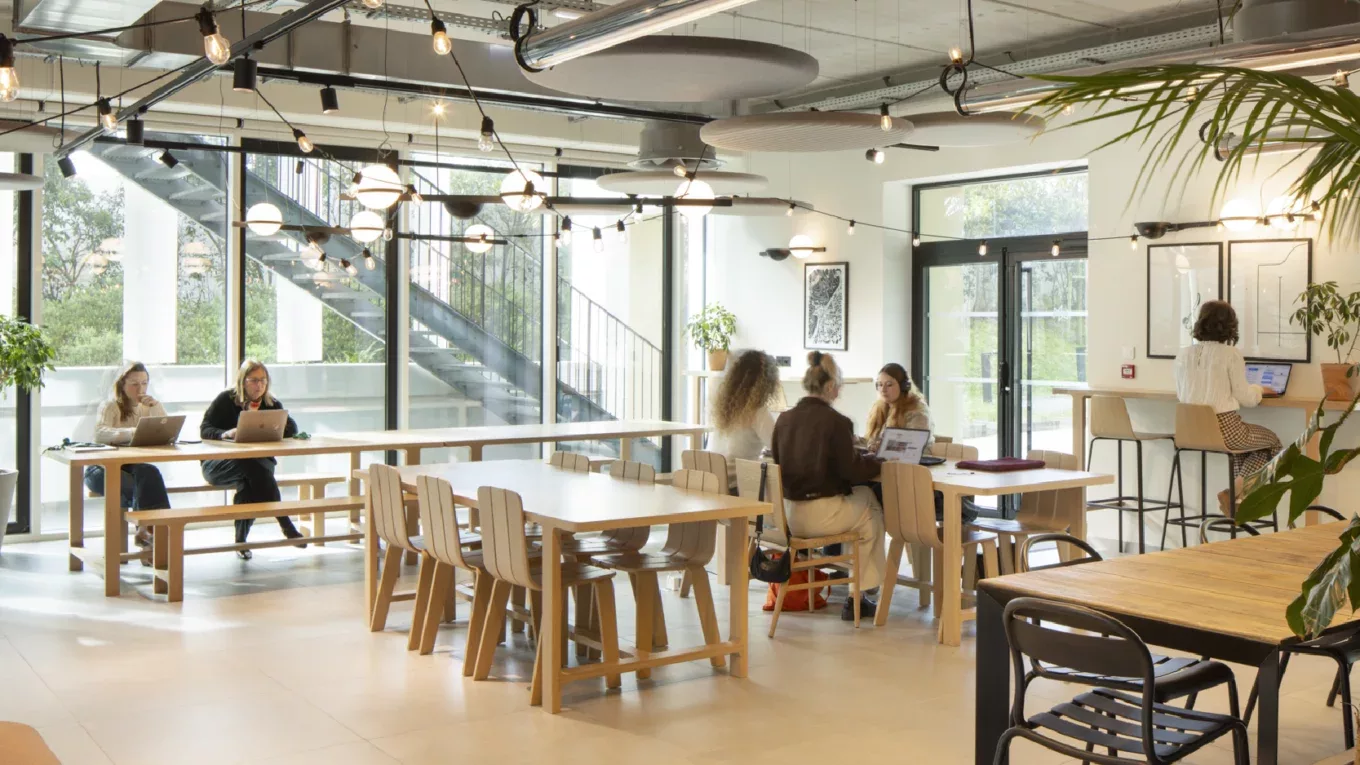
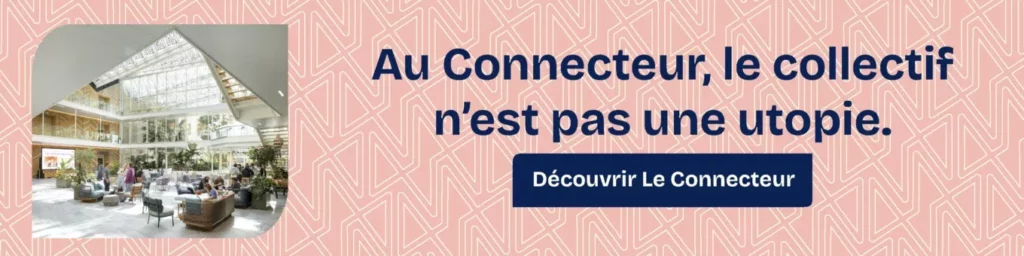
These models are built on networks, experimentation and distributed cooperation. In Biarritz, Le Connecteur is one example. This coworking space on the Basque coast These models are built on networks, experimentation and distributed cooperation. In Biarritz, Le Connecteur is one example. This coworking space on the Basque coast aims to recreate a local ecosystem where companies, start-ups, freelancers, researchers, training providers and public bodies can pool resources, skills and networks. This approach is part of a wider transformation of work: the company is no longer seen as an isolated structure, but as a node within a web of relationships, collaborations and local communities. Le Connecteur champions the idea of ‘working where you want to live’, bringing together local roots, hybrid working, innovation and cooperation.
For Stéphane Hugon, these new ecosystems reflect the emergence of more flexible organisations, which he describes as ‘archipelago’ systems. Unlike the classic pyramid model, these structures rely on a multitude of autonomous but interconnected players (companies, freelancers, researchers, local authorities and communities) able to cooperate on an ad hoc basis around shared projects, resources or interests. In this form of ‘neo-mutualism’, value lies less in the company on its own than in its ability to create connections, share knowledge and drive collective momentum across a region.
Sociocracy 3.0: governing as a network
These ways of working draw on hacker, maker and open-source cultures, which are built on knowledge sharing and decentralised cooperation. Some organisations are now experimenting with forms of governance inspired by sociocracy or blockchain. Stéphane Hugon points in particular to the emergence of a ‘sociocracy 3.0’, made possible by digital tools. Blockchain-based systems such as Aragon, for example, allow decisions to be distributed and tracked transparently, without going through a centralised hierarchy.
In his view, these tools pave the way for ‘archipelago’ organisations: collectives made up of autonomous but interconnected players, able to cooperate quickly on shared projects. The challenge is no longer just to run a company from the top down, but to orchestrate far more mobile and distributed networks of skills and communities.
François-Xavier de Vaujany adds a further point: the most powerful utopias today are not necessarily phalansteries or cooperatives, but those linked to artificial intelligence and the promise of organisations ‘augmented’ by technology. This comes with a risk: replacing visible administrative rules, which can be challenged, with far more opaque algorithms.
Behind the utopia: the search for a more ‘liveable’ capitalism ?
According to Stéphane Hugon, these models, whether new or revived, do not seek to break away from capitalism but to rebalance it by bringing more trust and cooperation back into organisations. In these more horizontal, networked structures, the ability to cooperate becomes as important as technical expertise. The challenge is no longer just to produce high-performing individuals, but teams able to work well together over the long term.